AI
From Chatbots to Cognitive Infrastructure
Jan 27, 2026
Written by David, co-founder at Inflectiv.ai
Moltbot's timing could not be better. Released only days ago it has already gone viral across developer and operator circles, not because it is flashy, but because it feels structurally right. Moltbot does not present itself as a demo or a toy. It behaves like an execution surface: agents embedded directly into the environments where work already happens, persistent, reachable, and capable of acting. In a landscape crowded with experimental tooling and fragile abstractions, Moltbot stands out as practical, opinionated, and immediately useful - arguably the most compelling execution-first agent system to emerge so far.

That distinction matters. Most agent projects today showcase intelligence. Moltbot focuses on where intelligence shows up.
But execution surfaces alone do not define a computing stack. Every major shift in software has eventually bottlenecked on a deeper layer: memory, state, and ownership of intelligence itself. That is where the next decade will be decided.
Exploring the joint potential of Moltbot and Inflectiv
The past decade of software has been defined by interfaces. Dashboards, SaaS panels, and ever more complex user experiences attempted to tame growing system complexity. The next decade reverses this trend. Interfaces recede. Agents act, decide, and communicate in human-native environments such as chat, voice, and ambient notifications.
In this emerging paradigm, two infrastructure primitives become decisive:
Where agents live and act
What agents know, remember, and can economically rely on
Inflectiv and Moltbot sit cleanly on opposite sides of this divide. Together, they outline the difference between agents that merely function and agents that can be trusted, reused, and scaled.
The shift from tools to agents
Moltbot represents a growing class of messaging-first agent frameworks. Instead of forcing users into new applications, it embeds AI agents into existing communication layers such as Telegram, Slack, Discord, or WhatsApp. The agent feels less like software and more like a colleague: persistent, reachable, and capable of acting across systems.
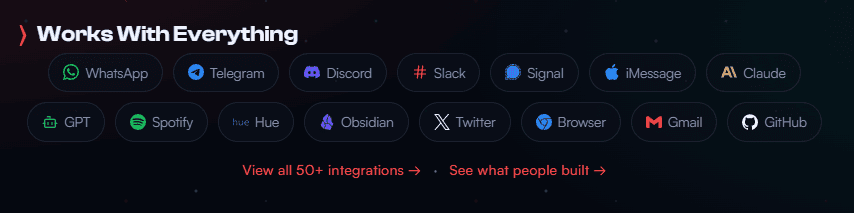
This is the right execution model. However, this is also where most agentic systems quietly break down.
Today’s agents reason over unstructured prompts, brittle context windows, or ephemeral session memory. They rely on private heuristics rather than durable intelligence. This leads to hallucinations, inconsistent behavior, and knowledge that cannot be reused or audited.
This is not a tooling problem. It is an intelligence infrastructure failure.
This is precisely the problem space Inflectiv addresses.
Inflectiv as agent-native intelligence infrastructure
Inflectiv is designed around a simple but powerful premise: intelligence that cannot be structured, persisted, and priced will not compound.
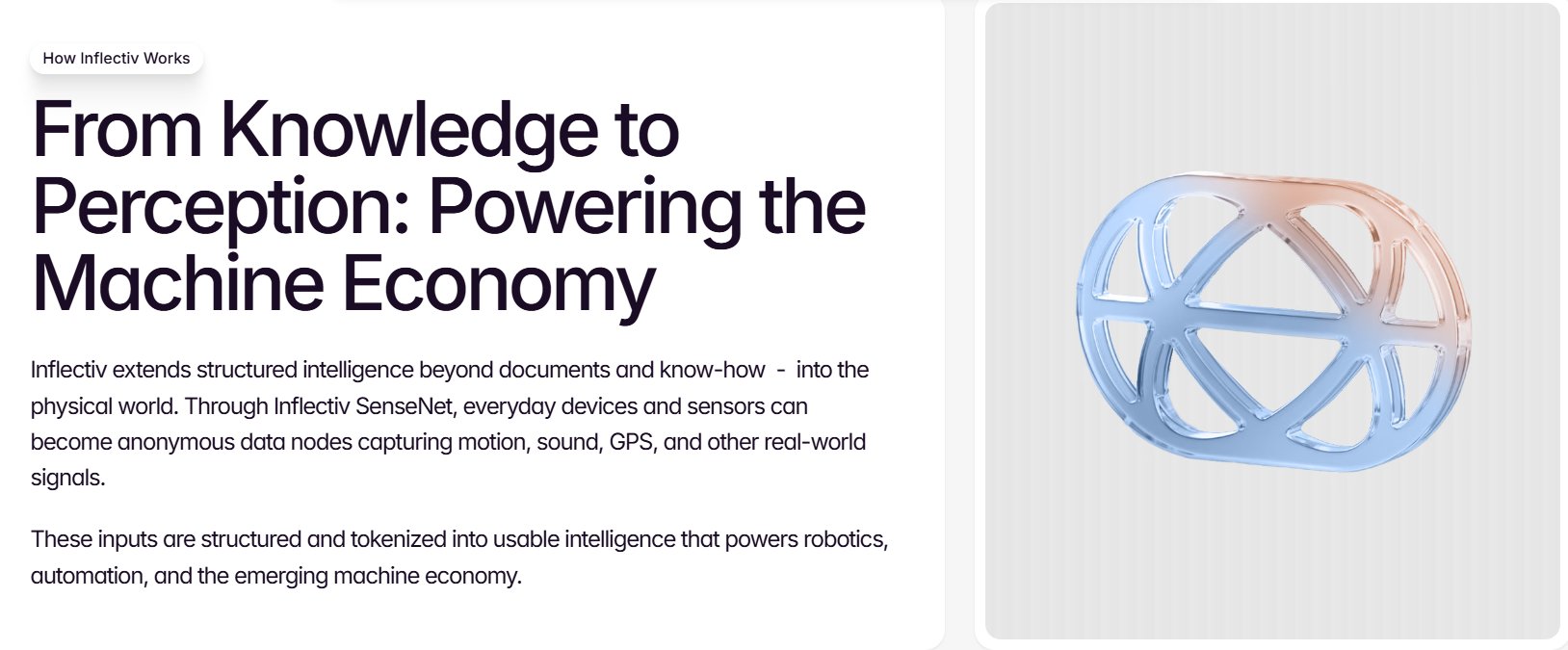
Rather than treating knowledge as text blobs or UI-bound dashboards, Inflectiv converts documents, research, SOPs, datasets, and signals into structured intelligence objects that agents can reliably query and reason over.
When combined with Moltbot, Inflectiv becomes the long-term cognitive substrate for agents operating in chat environments. Moltbot no longer “remembers” in an ad-hoc way; it retrieves intelligence from a verifiable source of truth. Knowledge stops being conversational residue and becomes infrastructure.
In effect, Moltbot answers how an agent acts, while Inflectiv answers what it knows.
Use case 1: Persistent organizational memory in chat
One of the most immediate applications of a Moltbot–Inflectiv pairing is organizational memory. Teams already live in chat. Decisions, rationales, and insights are exchanged daily and then lost. By backing a Moltbot agent with Inflectiv, organizations can turn conversations into structured intelligence:
Meeting summaries become queryable knowledge
Internal SOPs evolve dynamically as agents observe workflows
Institutional knowledge persists beyond employee turnover
Instead of searching old threads or wikis, users simply ask the agent and receive answers grounded in structured, versioned, auditable intelligence.
Use case 2: Dataset-powered agents as first-class consumers
A deeper shift appears when Inflectiv’s tokenized datasets enter the picture. Inflectiv enables datasets to be published, permissioned, and monetized as discrete assets. Moltbot agents become native consumers of these datasets, querying them on demand inside chat environments.
This changes the economics entirely:
Agents pay per query or per subscription,
dataset access is enforced programmatically,
usage is measurable, auditable, and composable.
In this model, agents are no longer just tools - they are economic actors, interacting directly with data markets.
Use case 3: Proactive intelligence and signal delivery
Moltbot's ability to initiate communication becomes particularly powerful when paired with Inflectiv’s structured signals. Rather than waiting for user prompts, agents can:
Monitor datasets for changes,
detect anomalies or thresholds,
push summaries, alerts, or recommendations proactively.
For example, a Moltbot agent could notify a team when a research dataset updates, when market conditions cross predefined boundaries, or when operational metrics deviate from historical norms - all driven by Inflectiv intelligence objects rather than ad-hoc scripts.
This shifts agents from reactive responders to continuous intelligence operators.
Use case 4: Vertical agents with domain-specific intelligence
Because Inflectiv intelligence can be domain-specific and modular, Moltbot agents can specialize deeply:
A compliance agent grounded in regulatory datasets
A research agent backed by proprietary academic corpora
A trading or analytics agent fed by structured market intelligence
Each agent behaves differently not because of prompt tuning, but because it draws from a different intelligence substrate. This separation of orchestration and cognition is what allows agent ecosystems to scale without collapsing into prompt chaos.
A broader architectural implication
Taken together, Moltbot and Inflectiv illustrate a larger shift in software architecture. Traditional stacks bind UI, logic, and data tightly together. Agent-native stacks decouple them:
Execution and interaction live at the edge (Moltbot),
intelligence lives in a liquid, programmable core (Inflectiv).
This decoupling enables reuse, monetization, and interoperability → not just for humans, but for autonomous systems.
Conclusion: Toward liquid intelligence in motion
Moltbot and Inflectiv do not solve the same problem. That is precisely why their intersection is powerful. One turns chat into an execution layer for agents. The other turns intelligence into a structured, tradable, machine-native asset.
The agent era is already here. The bottleneck is no longer models or interfaces. It is an intelligence infrastructure. Agents that rely on short-term memory and unpriced knowledge will remain fragile. Agents grounded in structured, tokenized intelligence will compound.
That is the layer Inflectiv.ai is built to own.